

Samsung Washer Repair in Los Angeles, CA
Los Angeles's hard municipal water can leave mineral deposits inside washing machine components, accelerating wear on drums, pumps, and seals over time. Ross Appliance Repair connects Samsung washer owners across Los Angeles—from Silver Lake to Brentwood to Downtown—with local independent repair providers who diagnose and fix these common issues quickly, helping you avoid the cost and inconvenience of premature replacement.
Samsung Washer Repair Services for Los Angeles Homes
Los Angeles homeowners rely on washing machines to handle heavy household laundry, but the region's hard municipal water can accelerate mineral buildup inside Samsung washers—affecting water flow, drum movement, and the machine's overall lifespan. When a Samsung washer starts leaking, draining slowly, or won't complete its cycle, prompt repair becomes essential. Whether you're in Hollywood, Brentwood, or elsewhere across Los Angeles, a malfunctioning washer disrupts daily routines and leaves your family without a working appliance.
Ross Appliance Repair connects Los Angeles homeowners with local independent providers who specialize in Samsung washer diagnosis and repair. These providers focus on pinpointing the root cause—whether it's a clogged inlet valve, drum seal failure, control board issue, or pump malfunction—and addressing it directly rather than recommending replacement. They work with original and compatible parts, handle follow-up questions, and aim to restore your Samsung washer to reliable operation. When you need Samsung washer repair in Los Angeles, a quick call gets you matched with a responsive local provider ready to help.
Common Samsung Washer Error Codes
Write the exact code down before anything else — Samsung reuses similar codes across models, and the precise characters are what narrow it down. Seven of the twelve below are usually a quick check you can make yourself; the other five need a technician.
Samsung Washer 4C
Often clearable without a technician
What it means: The washer asked for water and did not get what it expected, so it has stopped rather than run a cycle dry. Samsung shows this as 4C on newer panels, 4E on older ones and nF on some models — one fault, three displays.
Why it happens: Almost always something before the machine rather than inside it: a supply tap not fully open, a kinked fill hose behind the unit, or the small mesh screens where the hoses meet the washer silted up with scale and grit.
What you can check: Check both taps are fully open, then pull the machine out far enough to see the fill hoses are not kinked. If that looks fine, turn the taps off, unscrew the hoses at the machine end and look at the inlet screens for debris.
When to call someone: If the supply is good and the screens are clear, the inlet valve on the machine is next, and that is where it stops being an owner check.
Samsung Washer Ub
Often clearable without a technician
What it means: The load has gone off balance in the tub and the washer will not spin it at speed, because an unbalanced drum at spin speed can damage the machine.
Why it happens: Usually one heavy item on its own — a towel, a bath mat, a single pair of jeans — or a load that has twisted into a rope on one side of the drum.
What you can check: Open the door, redistribute the load by hand and restart the spin. Adding a couple of similar-weight items often settles it; washing one heavy item alone rarely spins well.
When to call someone: If it trips on every load including well-balanced ones, the suspension or the sensor reading the drum may need looking at.
Samsung Washer 4E
Often clearable without a technician
What it means: The same not-filling fault as 4C, shown as 4E on older Samsung panels.
Why it happens: A closed or partly closed tap, a kinked fill hose, or blocked inlet screens where the hoses connect.
What you can check: Work from the wall in: taps fully open, hoses unkinked, then the inlet screens at the machine end.
When to call someone: If water reaches the machine freely and it still will not fill, the inlet valve needs testing.
Samsung Washer SE
Often clearable without a technician
What it means: Water is not leaving the machine at the rate the cycle expects, or is not leaving at all. Shown as 5E, SE, 5C or nd depending on the panel.
Why it happens: The debris filter at the bottom front catches coins, hair grips and lint and eventually packs solid. A kinked drain hose or a standpipe that cannot take the flow does the same thing from further down the line.
What you can check: Open the small flap at the bottom front, drain the residual water into a tray and clean the filter. Then check the drain hose behind the machine for kinks and that it is not pushed too far into the standpipe.
When to call someone: If the filter is clean and the hose run is clear, the drain pump itself needs testing.
Samsung Washer UE
Often clearable without a technician
What it means: The same unbalanced-load condition as Ub, shown as UE on some Samsung models.
Why it happens: A single heavy item, or a load that has bunched to one side of the drum.
What you can check: Redistribute the load by hand and restart the spin.
When to call someone: If balanced loads also trip it, the drum suspension is worth checking.
Samsung Washer dC
Often clearable without a technician
What it means: The washer cannot confirm the door is shut and locked, so it will not start or will stop mid-cycle.
Why it happens: Most often laundry caught in the door seal stopping it closing flush, or a door that has been slammed rather than pushed shut.
What you can check: Open the door fully, clear anything caught around the seal, and close it firmly without forcing it. Check the latch and the strike plate for anything obstructing them.
When to call someone: If nothing is obstructing it and the lock still will not engage, the door lock assembly is the usual cause.
Samsung Washer SUd
Often clearable without a technician
What it means: The washer has detected far more foam than the drum is designed to handle, and is pausing to clear it before continuing.
Why it happens: Usually too much detergent, or a standard detergent used in a high-efficiency machine, which foams several times more than an HE formula.
What you can check: Let the machine run its own suds-clearing routine rather than cutting the cycle short. Next load, reduce the dose and check the detergent is HE-rated if your machine needs one.
When to call someone: If it appears with a correct HE dose, something may be holding water in the drum and it is worth having checked.
Samsung Washer 5C
Often clearable without a technician
What it means: The same not-draining fault as 5E and SE, shown as 5C on some Samsung panels.
Why it happens: A packed debris filter at the bottom front, a kinked drain hose, or a standpipe that cannot take the flow.
What you can check: Clean the filter behind the flap at the bottom front, draining the residual water into a tray first, then check the hose run behind the machine.
When to call someone: If the filter is clean and the hose is clear, the drain pump needs testing.
Samsung Washer nF
Often clearable without a technician
What it means: The washer is not filling — the same fault Samsung shows as 4C and 4E on other panels.
Why it happens: A tap that is not fully open, a kinked fill hose, or the inlet screens where the hoses meet the machine blocked with scale and grit.
What you can check: Check both taps, straighten the hoses, then turn the taps off and inspect the inlet screens at the machine end.
When to call someone: If water reaches the machine freely and it still will not fill, the inlet valve is next.
Samsung Washer OE
Usually needs a technician
What it means: There is more water in the tub than there should be, so the washer has stopped filling and is trying to pump out.
Why it happens: Normally the inlet valve passing water when it has been told to close, rather than anything to do with the load or detergent.
What you can check: Turn the supply taps off at the wall so no more water can arrive. There is no owner-side fix for a valve that will not shut.
When to call someone: Promptly — a valve stuck open is a flood risk as well as an error code.
Samsung Washer 0E
Usually needs a technician
What it means: The same overfill condition as OE, shown with a zero on some panels.
Why it happens: An inlet valve letting water through when it should be closed.
What you can check: Shut the taps at the wall to stop the fill. Nothing else here is an owner check.
When to call someone: Promptly, for the same reason as OE.
Samsung Washer ddC
Often clearable without a technician
What it means: The AddWash door — the small hatch in the main door — is not registering as closed and latched.
Why it happens: It is easy to push shut without seating the catch, and a trapped sock or glove will stop it closing flush.
What you can check: Open the AddWash door fully, clear anything caught in it, and press it closed until the catch engages.
When to call someone: If it is properly shut and still reads open, the hatch switch needs checking.
Samsung Washer HE
Usually needs a technician
What it means: A fault in the heater circuit, so the machine cannot bring the wash water up to the temperature the cycle asked for.
Why it happens: A component failure rather than anything that builds up, so it usually appears without warning.
What you can check: Nothing here is an owner check — the heater and its circuit are inside the machine.
When to call someone: When you see it. Cold-water cycles may still run, but the machine is not doing what the programme selected.
Samsung Washer 5E
Often clearable without a technician
What it means: The same not-draining fault Samsung shows as SE and 5C on other panels.
Why it happens: A packed debris filter at the bottom front, a kinked drain hose, or a standpipe that cannot take the flow.
What you can check: Open the flap at the bottom front, drain the residual water into a tray and clean the filter, then check the hose run.
When to call someone: If the filter and hose are clear and it still will not drain, the drain pump needs testing.
Samsung Washer LE
Usually needs a technician
What it means: Moisture has been found somewhere inside the machine it should not be — a leak, not a setting.
Why it happens: Water escaping from a hose connection, a seal or the tub reaches a sensor that shuts the cycle down.
What you can check: Turn the supply taps off at the wall and stop using the machine. The code says water is escaping but not from where.
When to call someone: This needs a technician — tracing the source means getting behind or under the machine.
Samsung Washer 3E
Usually needs a technician
What it means: A motor fault — the drive is not behaving the way the control expects.
Why it happens: A failure in the motor or its control circuit rather than anything to do with the load or detergent.
What you can check: Nothing here is an owner check. A single power-cycle at the breaker clears a one-off glitch; a code that returns is real.
When to call someone: If it comes back after a power cycle, the motor circuit needs testing.
| Code | What it means |
|---|---|
| Ub / UE / U6 | The load is unbalanced inside the tub, so the washer cannot spin it safely. |
| 5E / SE / 5C / nd | Water is not draining at the rate it should, or is not draining at all. |
| dC / dC1 / dL | The door is not being detected as closed and locked, so the cycle will not run. |
| SUd / Sd | An over-sudsing condition has been detected and the machine is pausing to let the foam clear. |
| OE / 0E / OC | There is too much water in the washer, which normally means the inlet valve is passing water when it should be shut. |
| LE / 1C | Moisture has been detected somewhere inside the machine that it should not be, which is a leak rather than a setting. |
| HE / HC | A fault in the heater circuit, so the machine cannot bring the water up to temperature. |
| 3E / 3C | A motor fault — the drive is not behaving as the control expects. |
| tE / tC | The temperature sensor is reporting a reading outside the range the cycle allows. |
| bE2 / 6E2 | A button on the control panel is reading as stuck or continuously pressed. |
Don't see your code? Call (213) 556-3688 — we'll help you track it down.
Common Samsung Washer Problems We Fix
Won't Drain
A clogged drain filter, kinked hose, or pump failure often stops water from emptying. The local provider Ross Appliance Repair connects you with will diagnose the blockage or defect and restore proper drainage.
Leaking Water
Worn door seals, inlet valve leaks, or loose hose connections cause puddles around your washer. A local technician will identify the source—whether seal, valve, or connection—and repair it to stop the leak.
Not Spinning
A faulty lid switch, drum bearing wear, or motor issue prevents the drum from turning. The provider you're connected with will test these components and replace or repair what's causing the spin failure.
Error Code on Display
Samsung washers display codes like 4C to signal drain problems, sensor faults, or water-level errors. A local repair provider will read the code, run diagnostics, and fix the underlying issue.
Loud or Vibrating
Foreign objects in the drum, worn drum rollers, or an unbalanced load create noise and shaking. The independent provider Ross Appliance Repair connects you with will find and remove the cause or replace worn parts.
Won't Start
A broken door latch, power issue, or control board fault may prevent your washer from running. A local technician will test the latch, electrical supply, and board to get your machine back to work.
Why Los Angeles Homeowners Choose Ross for Samsung Washer Repair
Fast Local Samsung Washer Repair
Ross connects you with independent Samsung washer repair providers nearby, reducing wait times. Whether you're in Hollywood or Silver Lake, a local technician can reach your home quickly when your washer breaks down.
Samsung Washer Repair You Can Trust
Clear communication throughout Samsung washer repair keeps you informed about what's wrong and what's needed. Transparent explanations help you understand the work and feel confident in the solution before it begins.
Thorough Samsung Washer Repair Solutions
Independent providers connected through Ross handle Samsung washer repair comprehensively, addressing root causes rather than quick fixes. Proper diagnosis and complete repair work help your washer run reliably again.
Hard Water & Samsung Washer Durability
Los Angeles's hard water supply can accelerate mineral buildup in Samsung washers, affecting performance over time. Experienced local providers know how water quality impacts your machine and can advise on maintenance or repair needs specific to the region.
How Our Repair Service Works
Schedule Your Samsung Washer Repair
Contact Ross Appliance Repair to describe your Samsung washer issue—whether it's a drainage problem, drum malfunction, or control panel error. We'll connect you with an independent local repair provider in Los Angeles who can assess your specific model and arrange a visit.
Samsung Washer Diagnosis & Assessment
The technician will inspect your Samsung washer, test its cycles, and identify the root cause of the failure. Los Angeles's hard water can accelerate mineral buildup in Samsung washers, and the technician will check for scale damage or valve blockages that may be contributing to the problem.
Complete the Samsung Washer Repair
Once the issue is confirmed, the independent provider will discuss repair options and costs with you. They'll perform the necessary work—whether replacing a pump, clearing clogs, or fixing electrical components—and test your Samsung washer before finishing.
Need appliance repair in Los Angeles? Our technicians can help fast.
Call (213) 556-3688More Repairs for This Brand
Samsung Washer Repair FAQ — Los Angeles, CA
Samsung Washer Repair addresses issues like drum problems, water leaks, spinning failures, error codes, and control board malfunctions. A technician will diagnose the specific problem, explain what's needed, and handle parts replacement or repair work. Most repairs are completed in a single visit, though some issues may require ordering parts.
Ross Appliance Repair connects you with independent local providers who typically respond quickly in the Los Angeles area. Many offer same-day or next-day scheduling when availability allows. Call or request service online, and a provider will confirm a time that works for your home.
Repair costs depend on the specific problem, which parts need replacement, and your machine's model. Service calls, diagnostics, labor, and parts are all factored in. Each independent provider sets their own pricing, so it's best to contact them directly for an estimate based on your washer's symptoms.
Before the technician arrives, note any error codes or unusual sounds your washer makes, and have the model number ready. Clear the area around the machine so the provider can access it safely. If water is leaking, place towels underneath and avoid running the machine until it's repaired.
Los Angeles's water supply contains minerals that can accumulate inside washers over time. Using a water softener or running a cleaning cycle with washer cleaner periodically helps reduce buildup. Also check hoses for kinks, avoid overloading, and wipe rubber seals dry after each load to prevent mold and odors.
Yes—a broken washer disrupts your routine quickly. Los Angeles's hard water can speed up scale-related failures and electrical stress during power grid fluctuations, making prompt repair important. Delaying repair may worsen the problem or damage other parts, so reaching out to a local provider as soon as you notice trouble is wise.
Samsung Washer Repair Across Los Angeles
Los Angeles's water supply tends toward the harder end of the mineral spectrum, which can affect how Samsung washers perform over time. Mineral buildup in fill valves, hoses, and internal components is a common issue in the region, and it often develops gradually—sometimes without obvious signs until the machine stops filling properly or cycles slow down. Regular maintenance and timely repairs become especially important in areas throughout Los Angeles where water hardness is higher, whether you're in Hollywood, Silver Lake, or anywhere else across the city.
Power reliability also matters for Samsung washer longevity. Los Angeles occasionally faces periods of grid strain during peak demand, and electrical fluctuations can stress the control boards and motors that make modern washers run. When you need a Samsung washer repair in Los Angeles, a local independent provider can assess whether hard-water scale, electrical wear, or another cause is behind the breakdown and get your machine back in service. Ross Appliance Repair connects you with qualified local technicians who understand how these regional factors affect appliance performance.
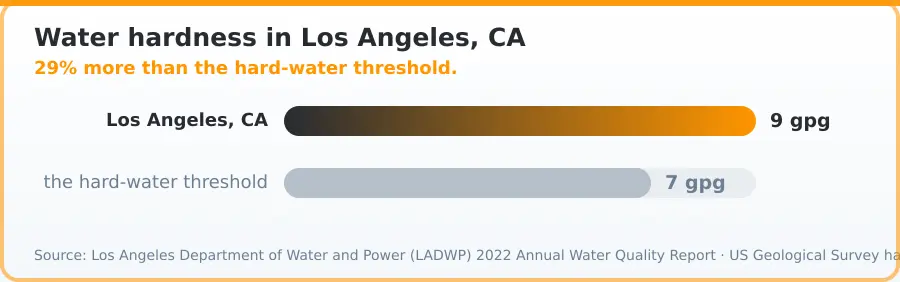
| Location | Water hardness vs the hard-water threshold (gpg) |
|---|---|
| Los Angeles, CA | 9 |
| the hard-water threshold | 7 |
Source: Los Angeles Department of Water and Power (LADWP) 2022 Annual Water Quality Report · US Geological Survey hardness classification. Retrieved October 27, 2026.
Homeowner Safety Toolkit
Verify Your Los Angeles, CA Appliance Repair Company
Before you hire anyone, use these independent national resources to confirm credentials, standards, and track record.
BBB
Look up any appliance repair company's complaint history, customer reviews, and accreditation status — a free, independent check before you hire.
Check StandingCPSC
Check whether your specific appliance has an open safety recall before paying for a repair — some recalls cover the fix or a replacement for free.
Check for RecallsNFPA
A poorly repaired dryer, range, or water heater is a real fire risk. The National Fire Protection Association's home safety guidance covers what to check after any appliance service.
Appliance Fire Safety TipsBook your Los Angeles appliance repair today.
Call (213) 556-3688Areas We Serve in Los Angeles, California

Coverage centres on Los Angeles, CA and reaches 8 surrounding communities. Response time is what matters most in the hours after a problem is found, so knowing the ground is part of the job.
Los Angeles, CA Information
Los Angeles, CA spreads across a sprawling coastal basin where nearly 3.8 million residents share space with one of the most diverse economies in the country. Entertainment and media production remain the city's signature industries, but the Port of Los Angeles also makes it a vital hub for international trade, while aerospace, technology, tourism, and a long tradition of fashion and apparel manufacturing round out the mix. Major institutions like UCLA, USC, and Cedars-Sinai add further depth and stability to the local job base.
That variety shows up in the city's neighborhoods, too — from the creative energy of Silver Lake to the quieter, tree-lined streets of Eagle Rock. It's a place where industries and cultures constantly overlap, giving Los Angeles a resilience and character all its own.

Photo: Billy Hathorn, CC BY-SA 3.0